
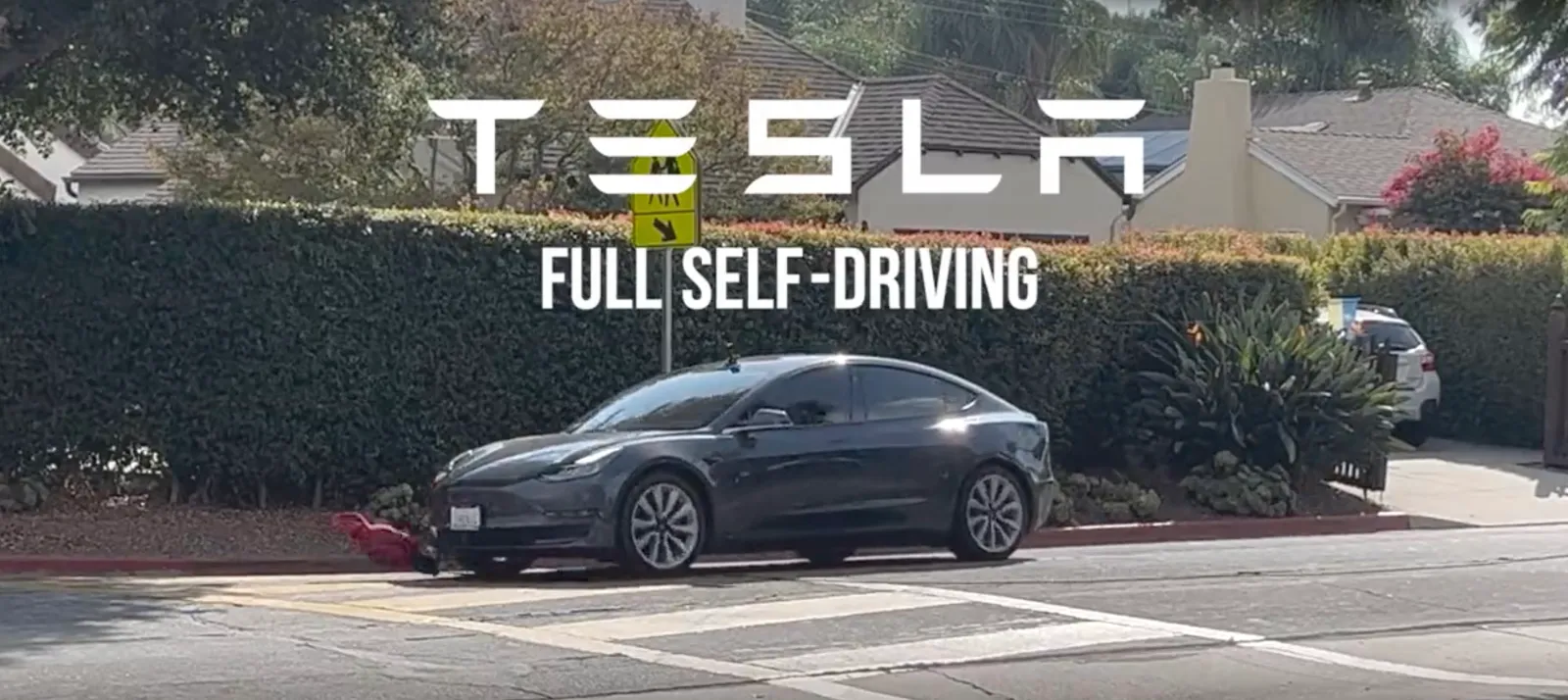
Tesla’s long-awaited Full Self-Driving launch in Europe is already running into the same reckoning that blew up in Australia last year: HW3 owners are realizing they paid for something Tesla has now admitted it can’t deliver, and they’re starting to organize.
A Dutch Model 3 owner who paid €6,400 for FSD back in 2019 has launched a collective claim website to bundle HW3 + FSD owners across the EU.
The effort comes from Mischa Sigtermans, a 2019 Model 3 buyer and one of the first Tesla owners in the Netherlands. In a post on X that racked up 75,000 views overnight, Sigtermans said he waited seven years for Tesla to deliver the autonomy he was sold, and finally gave up after last week’s FSD approval in the Netherlands made clear his car would be left out.
“Tesla owes me €6.800. And if you’re a HW3 + FSD owner, they owe you too,” Sigtermans wrote. “I waited 7 years. SEVEN years!”
His new site, hw3claim.nl, is specifically aimed at bundling European Tesla owners who paid for the “Full Self-Driving” package on HW3 cars so they can either negotiate with Tesla or, if it comes to it, pursue a legal claim.
The trigger: FSD approved in the Netherlands — but not for HW3 cars
The Dutch vehicle authority RDW granted Tesla type approval for FSD Supervised under UN R-171 on April 10, a milestone we covered here. It’s the first full type approval for FSD anywhere in the European Union and the gateway to a broader rollout across the bloc this summer.
The catch, and the one that’s now galvanizing owners, is that the approved build only runs on Tesla’s newer AI4 computer. Cars with HW3 (FSD Computer 3.0) get nothing at launch. Tesla has vaguely promised a stripped-down “v14 Lite” for HW3 sometime in Q2, but that’s a different product than what was sold.
In the Netherlands, the FSD package was priced at €5,300 when pre-ordered at configuration and rose to €7,500 after delivery. Sigtermans paid €6,400. Every Dutch HW3 owner who bought FSD paid a similar amount, which is why the individual claim number is so consistent.
Tesla’s own patent says the HW3 workaround can be “inoperable”
Here’s the problem with the v14 Lite plan: Tesla has essentially admitted in writing that it may not work.
Tesla’s own US patent filing US20260017503A1, which describes the math trick Tesla is using to squeeze a modern FSD model onto HW3, acknowledges that the workaround can render the system “inoperable” for perception units of an autonomous driving system. That’s not a rumor or a critic’s interpretation, that’s the language in Tesla’s own patent, which we wrote about in January.
That sits on top of Tesla VP of AI Ashok Elluswamy’s own acknowledgment on August 21, 2024, that HW3 runs a “relatively smaller model” than AI4 with workarounds to emulate operations that run natively on AI4. And on top of Elon Musk’s admission in January 2025 that “we will need to replace all HW3 computers in vehicles where FSD was purchased.”
Musk called the replacement “painful and difficult” on the Q4 2024 earnings call and said he was “kind of glad that not that many people bought the FSD package.” The problem is that even by Tesla’s own count, roughly 4 million vehicles shipped with HW3, and hundreds of thousands of those owners paid for FSD.
Fifteen months after that earnings-call admission, Tesla still has no concrete plan for HW3 owners — no hardware retrofit program, no refund policy, no timeline.
Australia showed what comes next
Dutch owners are not the first to react. In October 2025, thousands of Tesla owners joined a class-action lawsuit in Australia alleging Tesla misrepresented FSD and ADAS capabilities. That action, led by Echo Law, covers Model 3 and Model Y owners who purchased or leased between May 2021 and February 2025, and it was directly triggered by Musk’s HW3 admission.
Law firm director Rebecca Jancauskas summarized the complaint at the time: “Tesla made promises about their vehicles’ safety, performance and features such as their ‘Full Self-Driving,’ but we have found a lot of these promises are falling flat.”
Europe is a meaningfully tougher legal environment for Tesla on this issue than the US. EU consumer law gives buyers strong rights around conformity with what was advertised at point of sale, and the Netherlands, Germany, and France all have mature collective-redress frameworks. A bundle of thousands of HW3 owners in multiple EU countries is not a fringe risk — it’s the path Tesla was always going to hit once FSD actually shipped in Europe.
Electrek’s Take
Top comment by Bobb Bobb
The team is hard at work. Cumulative hours allocated at Tesla for the HW3 re-design: 0.0
We’ve been saying this for a year: Tesla launching FSD in Europe was always going to be the moment the HW3 problem stopped being abstract and became a bill. Australia was the warm-up. The Netherlands is the real thing, because EU consumer protection law is stronger and because there’s now a documented paper trail — Tesla’s own patent, Musk’s own words on an earnings call, Tesla’s own VP of AI — establishing that the company sold something it cannot deliver on HW3.
Sigtermans’ early effort is gaining momentum and it will be interesting to see where it goes. “V14 Lite” is not going to satisfy an owner who paid €6,800 for “Full Self-Driving”. Tesla sold them unsupervised self-driving, and a “lite” version of something that is not even unsupervised self-driving simply won’t do.
Yet, we are 15 months after the admission that Tesla will have to replace HW3 computers, and there’s still no timeline.
I’m curious to see if Tesla will offer a refund, but I increasingly think this will have to end up in court.


FTC: We use income earning auto affiliate links. More.


Comments